Key takeaways
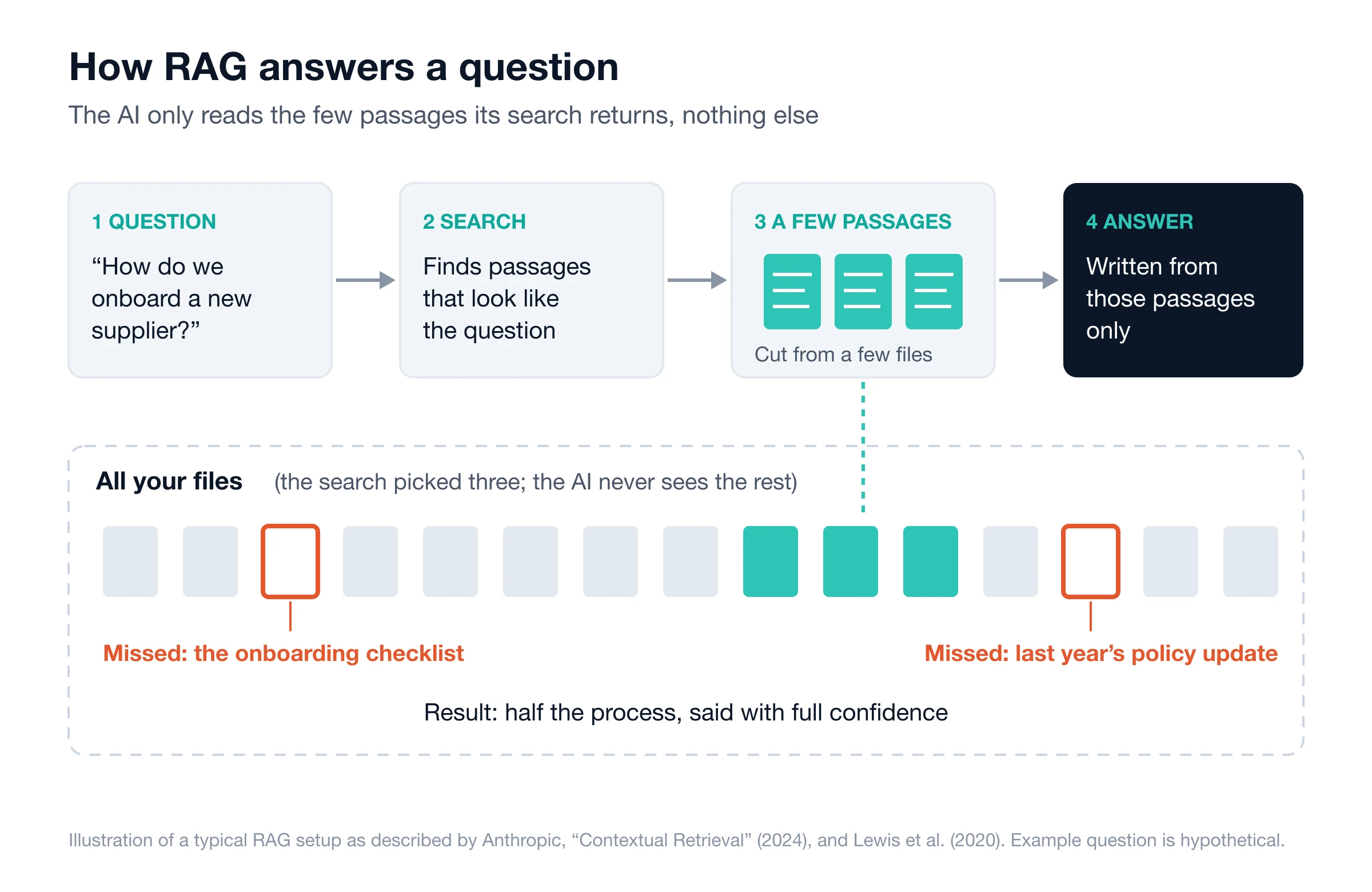
- RAG (retrieval-augmented generation) searches your files for a few passages that look like the question, and the AI answers from those passages only.
- It works well when the answer sits in one place: a contract clause, a current policy, an error code.
- It struggles when the answer is spread across many files, because it never sees the pages its search didn't return, and studies show RAG tools can still give wrong answers.
- Meistra, Dataotter's product in private beta, is designed to read all your files first, write a source-linked Knowledge Book and pass an exam with secret questions before anyone relies on it.
- Rule of thumb: if the answer is a record, use search such as RAG; if it is a way of doing things, an expert that has studied your files fits better.
Ask your company chatbot how to onboard a new supplier, and it answers in seconds, with a source. Your purchasing lead reads it and frowns: half the process is missing, because the rest lives in a checklist, two old emails and a policy update it never saw. That gap is the quickest answer to "what is RAG?"
Retrieval-augmented generation, RAG for short, is how most "chat with your documents" tools work. The AI first looks up a few passages in your files, then writes an answer from those passages. It's a good idea with a blind spot built in: the AI only ever sees the handful of pages its search turned up. In a 2024 Stanford test, three RAG legal research tools, from vendors that had marketed RAG as a fix for made-up answers, still gave a wrong or unsupported answer 17% to 33% of the time.
We build RAG systems, and we also built Meistra, which takes a different route. So here's where each one breaks, where each one fits, and a one-line test for telling which one you need.
What is RAG, in plain words?
Picture a new assistant with very fast legs and no memory. You ask a question. The assistant runs to the archive, grabs the three or four pages that look most like your question, and writes an answer using only those pages. Then it forgets everything.
That's RAG. The idea comes from a 2020 research paper by Patrick Lewis and colleagues, which paired a language model, the kind of AI behind ChatGPT, with a searchable copy of Wikipedia so its answers could be more factual and point to their sources.
Inside a company, the setup has three steps, as Anthropic explains in its guide to how these systems search. First, your documents are cut into small pieces called chunks, usually no longer than a paragraph or two. Second, every chunk goes into a search index that finds text by meaning rather than by exact words. Third, when someone asks a question, the system fetches the chunks that look most similar and hands them to the AI along with the question.
When RAG works well
RAG is good at questions whose answer sits in one place. "What's the notice period in our standard contract?" "Which version of the travel policy is current?" "What does error code TS-999 mean?" If one passage holds the answer, a decent search finds it, and the AI phrases it clearly and shows where it came from.
It also stays current: add a document to the index, and the next answer can use it, with no retraining. That's why RAG became the default for help desks, policy look-ups and product manuals. For those jobs, we still recommend it.
One shortcut before you build anything: if all your documents together are small, you may not need RAG at all. Anthropic notes that a knowledge base under about 500 pages can be handed to its AI in full with every question, with no search step in between.
RAG limitations: six places it falls short
The trouble starts with questions whose answer isn't written in one place. Six problems show up again and again. Five are documented in research. One, the fifth below, is our own view from building these systems.
It only sees the pages it fetched
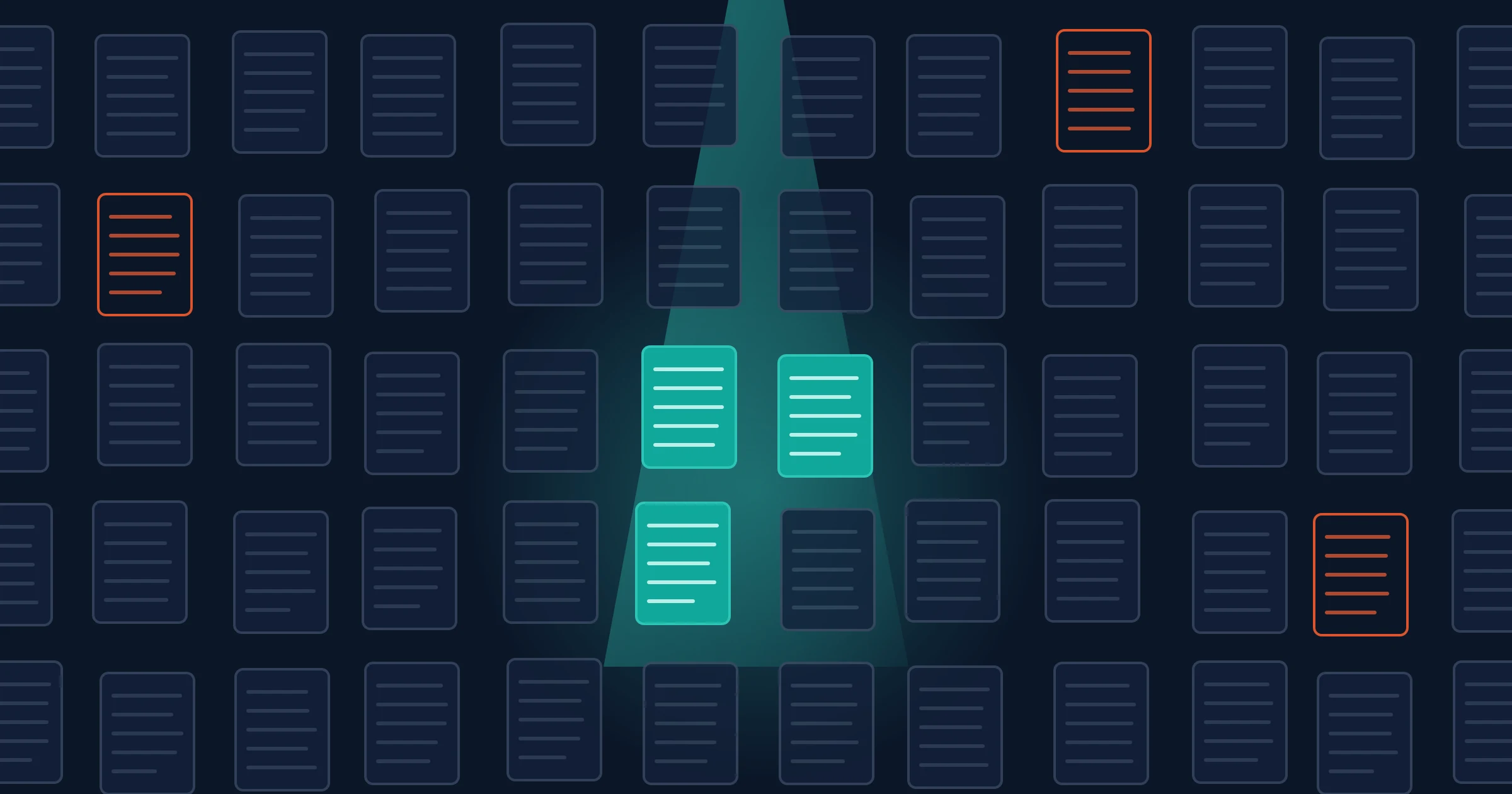
If the answer is spread across twenty documents, a RAG system sees part of it and fills in the rest. Microsoft Research's GraphRAG team wrote that standard RAG "struggles to connect the dots" when an answer has to be pieced together from scattered information. Asked "What are the top 5 themes in the data?", it performed, in Microsoft's word, "terribly", because nothing in that question points the search at the right pages.
Cutting documents into chunks cuts out context
A chunk loses the page around it. Anthropic's example is a chunk that reads "The company's revenue grew by 3% over the previous quarter." On its own, it doesn't say which company or which quarter. The search may not find it, and the AI may not understand it when it does. Company files are full of such sentences: "the usual procedure applies", "see the exception above".
The AI skims the middle
Fetching more chunks helps up to a point, then it hurts. A 2023 study called "Lost in the Middle" found that the language models of the time used information best when it sat at the start or the end of what they were given, and clearly worse when it was buried in the middle. Anthropic also warns that more chunks "can be distracting".
When search misses, it can still make things up
If the answer isn't in your files, a good RAG system should say "I don't know". A 2024 study of three real RAG projects by Barnett and colleagues found that questions close to the content, but without an answer in it, can fool the system "into giving a response". Some legal research vendors claimed RAG "eliminates" hallucinations, meaning the AI confidently inventing things, or guarantees "hallucination-free" citations. In 2024, Stanford researchers tested three such tools from LexisNexis and Thomson Reuters on legal research questions. Each gave a wrong answer, or cited a source that didn't back it up, 17% to 33% of the time. That's less often than GPT-4, but it isn't zero.
It doesn't learn how your company works
RAG never builds up an understanding of your warranty process, or of the lesson your service team learned across fifty repair reports. It improvises a fresh answer each time. When two files disagree, say an old and a new warranty period, nothing in a standard setup flags it. Barnett's team lists "contradicting information" among the reasons models fail to pull out the right answer.
You find out how good it is only after people rely on it
The main lesson from the Barnett study is blunt: "validation of a RAG system is only feasible during operation". In plain words, you can't fully test it before launch. Unless the team builds its own test set, nothing tells you how far to trust it, so your users find the mistakes for you.
Better RAG narrows the gaps, but doesn't close them
Anthropic adds a short note of context to each chunk before it's stored, which it calls contextual retrieval. Microsoft's GraphRAG first has the AI map the people, things and topics in your files and how they connect. Both improve the search, but the answer is still assembled at question time.
RAG doesn't know your company. It reads a few pages of it, very fast, every time you ask.
A different approach: let the AI study before it answers
That's the thought behind Meistra, a product we're building at Dataotter. Processes and lessons rarely live in one passage. They live between documents. So instead of searching at question time, Meistra reads everything first, writes the knowledge down, and is tested before anyone relies on it.
Meistra is in a private beta with a waitlist, so what follows is how it's designed, not a report of results. According to its own description of the method, it works in five steps:
- You upload your files and say in one sentence what it should learn, such as "handle warranty claims the way we do".
- It reads every page and writes each learning, process and SOP (standard operating procedure, the written step-by-step for a task) into a Knowledge Book, with the page each line came from. Where two files disagree, it stops and asks a person.
- It writes an exam from your files, not from its own notes, and locks a quarter of the questions away before studying starts.
- It studies until it passes, answering from the Knowledge Book alone. Every wrong answer sends it back to re-read that part of your files.
- The locked questions are opened once, at the end. That result is its certificate.
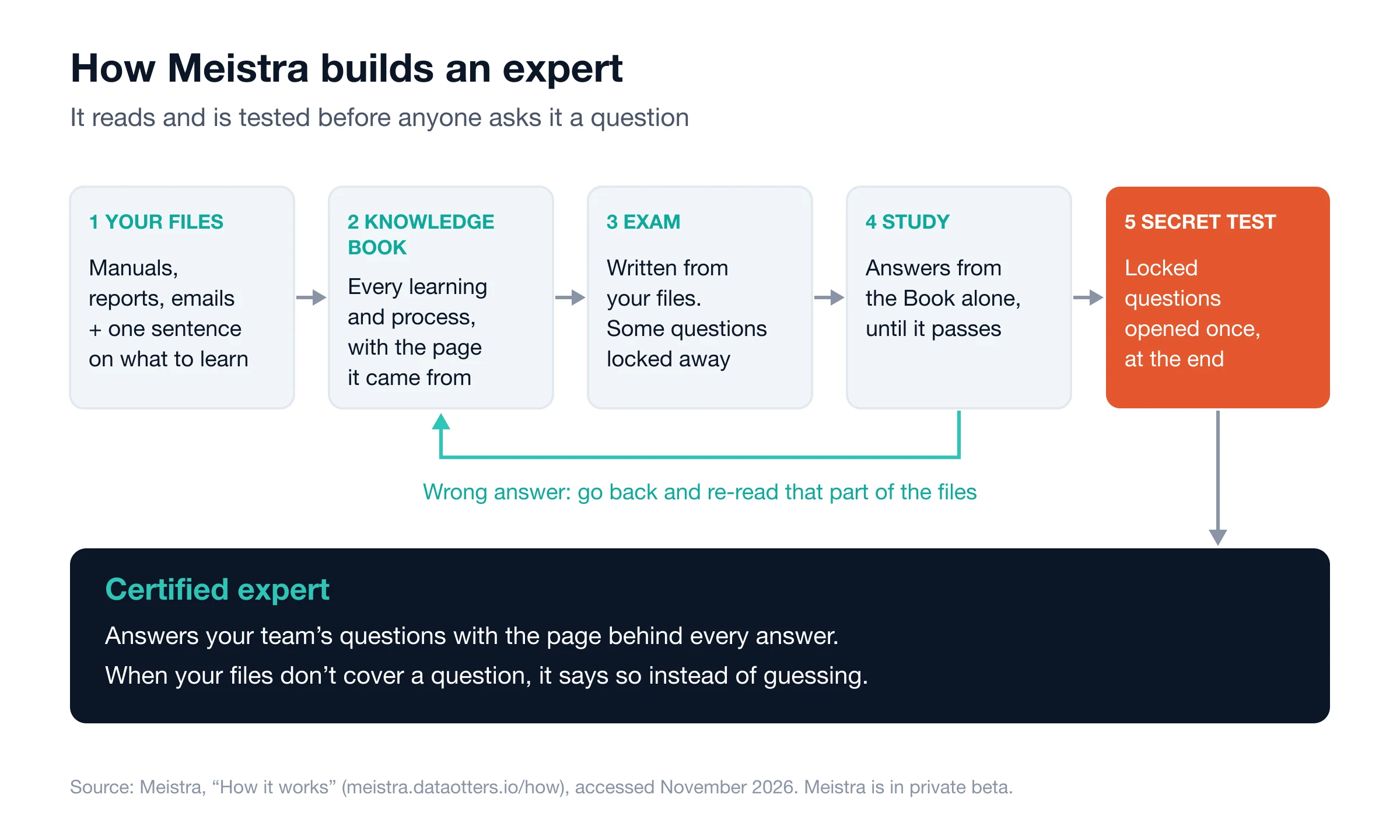
A few hard rules keep this honest. A learning without the passage it came from can't be saved. The part that writes the exam can't see the Knowledge Book, so it can't write itself an easy test. And only a person can settle a disagreement between files, in their own name.
This also reframes the "RAG vs fine-tuning" debate. Classic fine-tuning retrains the model itself, which nobody can open and correct. Meistra borrows the habits of training (study, test, keep a secret test) but trains a book people can read, not the model, as Dataotter's Hamiz Ahmed explains in his article on agentic fine-tuning. If a line is wrong, you correct that line.
RAG vs Meistra vs a general chatbot: which one fits?
| General chatbot (no company files connected) | RAG | Meistra | |
|---|---|---|---|
| What it reads | Its general training, plus whatever you paste in | A few passages that match each question | Every file you upload, before anyone asks |
| Answers spread across many files | Only if you paste them all in | Partly: it sees only what the search returns | Written down once, from all the files |
| Shows sources | Not for your company's facts | Yes, the passages it used | Yes, the page behind every answer |
| Learns your processes | No | No, it rebuilds each answer from scratch | Yes, as a Knowledge Book people can read and correct |
| When two files disagree | Can't know | Not flagged | Asks a person and records the decision |
| How you know it's right | You check it yourself | Usually from use after launch, unless you build a test set | An exam with locked questions, before launch |
| Look up one record (report 47, one customer) | Only if you paste it in | Its strength | Not for this; it says your files don't cover it |
| File types | Depends on the tool | Depends on the build | Text only: PDF, Word, plain text, scans with text |
| Available today | Yes | Yes, many tools | Private beta, waitlist |
| Setup effort | None | From off-the-shelf tools to custom engineering | Upload files, write one sentence; in the beta, the first expert is set up with you |
| Best for | Drafting and general questions | Looking up facts and records in large, changing archives | Processes, SOPs and lessons spread across many files |
Where RAG is still the right choice
Meistra doesn't replace RAG, and its own fit page says plainly why.
Meistra learns how work is done, not individual records. "What did report 47 conclude?" or "Who signed the contract with that customer?" are look-ups, and a RAG system answers them better. Meistra also learns from files at the moment it reads them, so stock levels, prices and order status belong in a live system. And it reads text only, not spreadsheets, drawings or photos.
Meistra's own rule of thumb works as a test for any tool: "If the answer is a way of doing things, it is for you. If the answer is a record, it is not." "How do we handle a complaint?" is a lesson. It's spread over many files and the same each time. "What did report 47 conclude?" lives in one file and should be looked up.
Many companies will end up with both: a search for records, and an expert for the way the work is done.
What this means for you
Before you buy or build anything, look at the questions your team actually asks.
- List the real questions. Ask the two or three people everyone queues up to see. Write down what they get asked in a normal week.
- Sort them into two piles. "How do we…?" questions are processes. "What did…?" or "Where is…?" questions are records.
- Test any RAG pilot on the hard pile. Look-ups will pass. Ask it questions whose answer spans several documents, and have the person who knows check the answers.
- Ask how quality will be measured before launch. If the answer is "we'll see how users like it", you now know who your testers are.
If your list is mostly records, a well-built search is the right tool; that's the kind of private RAG system we build. If it's mostly processes and lessons, that's the problem Meistra was made for, and the waitlist is open.
The models will keep getting smarter on their own. What they won't do on their own is read your files and write down how your company actually works. Whoever does that first, and tests it, will have the AI assistant people trust.
Frequently asked questions
What is RAG in simple terms?
RAG stands for retrieval-augmented generation. When you ask a question, the system first searches your documents for a few passages that look similar to it, then an AI writes the answer from those passages. It is how most chat-with-your-documents tools work.
What are the main RAG limitations?
RAG only sees the few passages its search returns, so answers spread across many documents come back incomplete. Cutting documents into small pieces strips out context, studies of earlier models found they used information in the middle of long inputs poorly, and it can still invent answers when the search misses. It is also hard to test before people start relying on it.
RAG vs fine-tuning: which is better for company knowledge?
RAG looks things up at question time and is good for facts that sit in one place and change often. Classic fine-tuning changes the model itself, which is good for style and skills but hard to inspect or correct as a store of facts. Meistra takes a third route: it trains a readable Knowledge Book instead of the model, and tests it with secret questions.
Does RAG stop AI hallucinations?
It reduces them but does not stop them. In 2024, Stanford researchers tested three legal research tools from LexisNexis and Thomson Reuters that are built on RAG. Each gave a wrong answer, or cited a source that didn't back it up, 17% to 33% of the time: fewer than GPT-4, but far from zero.
Is Meistra available now?
Meistra is in a private beta with a waitlist. You can sign up on its website and describe what know-how an expert should extract from your documents. In the beta, the first expert is set up together with you.
Sources
- Retrieval-Augmented Generation for Knowledge-Intensive NLP Tasks, Lewis et al., arXiv (NeurIPS 2020)
- Contextual retrieval in AI systems, Anthropic
- GraphRAG: Unlocking LLM discovery on narrative private data, Microsoft Research
- Lost in the Middle: How Language Models Use Long Contexts, Liu et al., arXiv (TACL 2023)
- Seven Failure Points When Engineering a Retrieval Augmented Generation System (full text), Barnett et al., arXiv
- Hallucination-Free? Assessing the Reliability of Leading AI Legal Research Tools, Magesh et al. (Stanford), arXiv
- Seven Failure Points When Engineering a Retrieval Augmented Generation System, Barnett et al., arXiv
- Meistra: Turn your company's knowledge into experts, Meistra (Dataotter)
- How it works, Meistra (Dataotter)
- Is it for you?, Meistra (Dataotter)