Key takeaways
- The EU AI Act already applies to companies that use AI tools, and national regulators have been able to enforce it since 2 August 2026.
- The strict rules for high-risk AI, such as software that sorts job applications or scores credit, were postponed to 2 December 2027 by the Digital Omnibus on AI, which has been in force since 27 July 2026.
- What applies today: build your staff's AI skills, label deepfakes, avoid banned practices, and make sure your chatbot says it's an AI (legally the provider's job, but often yours in practice).
- In Germany, the Bundesnetzagentur is the main AI supervisor since 29 July 2026, while BaFin keeps AI used directly in regulated financial business.
- For most companies, a training record, a list of AI tools and a label on the chatbot cover the rules that apply now.
If your company uses ChatGPT, Copilot or a chatbot on its website, the EU AI Act already applies to you. Since 2 August 2026, regulators can enforce it. If you only use AI rather than build it, the EU AI Act requirements for companies come down to four things. Train your staff, list where you use AI, tell people when they deal with a machine, and check that nothing falls into the "high-risk" group.
The heavy rules for high-risk AI, such as software that sorts job applications, were pushed back to December 2027. Many managers heard "postponed" and stopped reading, which is a mistake. The delay bought time for hiring tools and credit scoring. It didn't buy time for your chatbot.
Plenty of companies are still unsure. In a Bitkom survey of 603 German companies published in September 2026, 37% said they expect to be affected as users, and another 34% were still checking. This guide explains the law in plain words, but it is not legal advice.
What is the EU AI Act? Most companies are deployers, with fewer duties
The AI Act, officially Regulation (EU) 2024/1689, is an EU law that sets rules for AI based on how much harm a use could cause. It came into force on 1 August 2024 and switches on in stages.
It covers two main groups. "Providers" build an AI system, or have one built, and offer it under their own name, like OpenAI with ChatGPT. "Deployers" use an AI system at work, like your marketing team using ChatGPT. Most companies are deployers, and deployers have fewer duties.
In July 2026 the EU changed the law with the Digital Omnibus on AI, a package that changes several laws at once. It is no longer a proposal: it came into force on 27 July 2026.
The four risk levels, and where your AI tools land
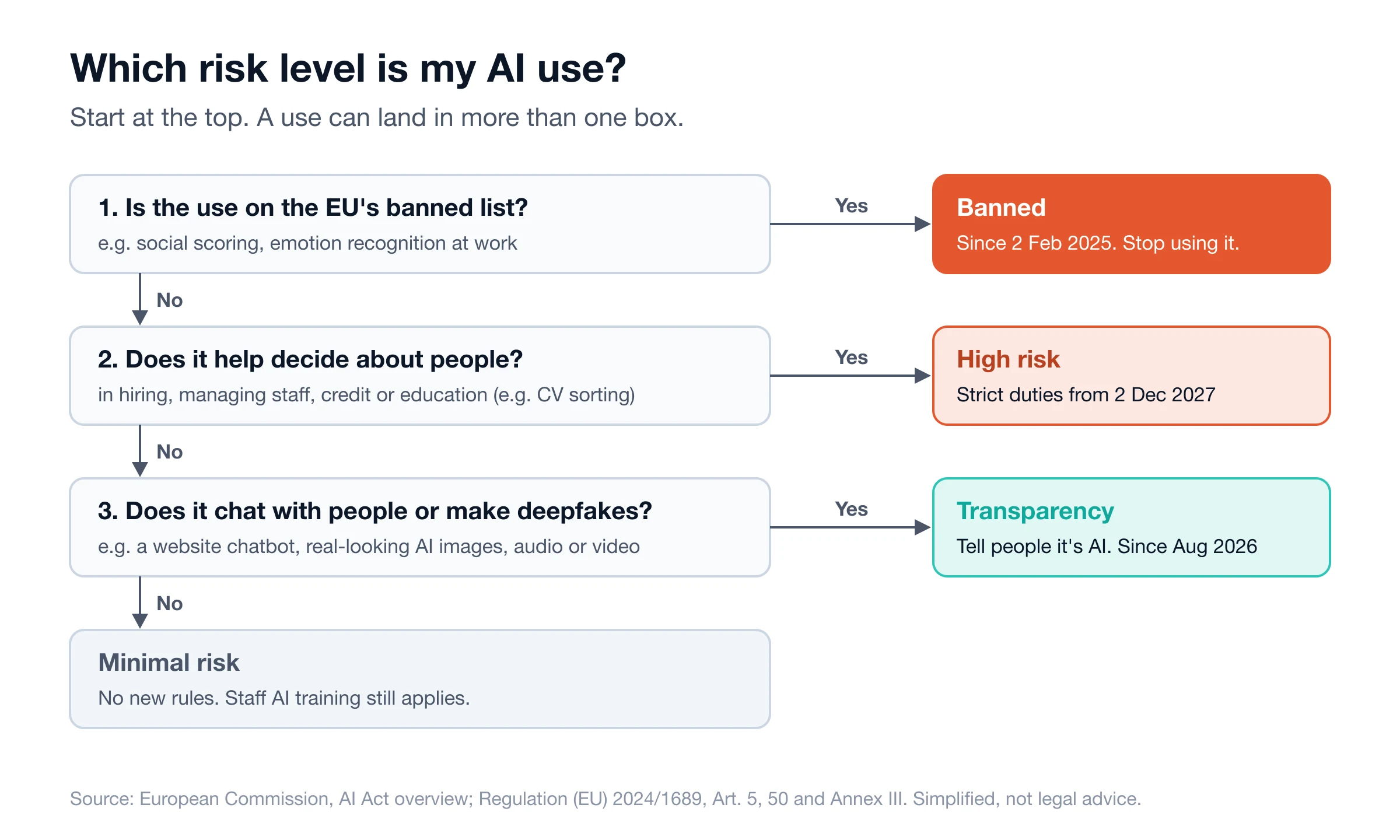
The law sorts AI uses into four levels, like a traffic light with a fourth light for "banned". The European Commission's overview describes them like this.
| Risk level | Examples | What it means for you |
|---|---|---|
| Unacceptable (banned) | Social scoring (rating people's behaviour to treat them better or worse), emotion recognition at work or in schools, manipulative AI | Don't use it. Banned since February 2025. |
| High risk | CV sorting in hiring, credit scoring that can deny a loan, scoring exams | Strict duties from 2 December 2027 |
| Transparency risk | Chatbots, deepfakes, AI-generated content | Tell people. Applies since August 2026. |
| Minimal or no risk | Spam filters, AI in video games | No new rules |
The Commission says the "vast majority" of AI systems used in the EU sit in the bottom row. In our reading, most office uses of ChatGPT or Copilot, such as drafting emails or summarising documents, end up in the bottom two rows.
The level depends on what you use the tool for, not which tool it is. ChatGPT writing a newsletter is minimal risk. The same kind of model ranking job applicants is high risk.
The banned list is short and mostly far from normal business. One line is easy to miss: emotion recognition at work. If an HR tool claims to read how motivated or stressed your staff are from their faces or voices, check it now.
What applies today, and what moved to 2027 and 2028
Here is the state of play on 15 November 2026, based on the Commission's official implementation timeline.
Already applies:
- 2 February 2025: the bans and the duty to build AI literacy (AI skills) among staff.
- 2 August 2025: rules for makers of general-purpose AI models, the big models behind tools like ChatGPT. That's OpenAI's problem, not yours.
- 2 August 2026: most of the rest. The transparency rules apply, and enforcement starts for the bans, transparency and AI literacy.
Still to come:
- 2 December 2026: a new ban on AI that creates sexual deepfakes of real people without consent or child sexual abuse material. Makers of AI tools already on the market before 2 August 2026 must also, by then, give their images, audio, video and text a machine-readable mark, such as a hidden watermark, that software can spot.
- 2 December 2027: rules for high-risk uses such as hiring, education, credit scoring and critical infrastructure (power, water and transport networks). This was 2 August 2026 before the omnibus.
- 2 August 2028: rules for AI built into regulated products such as machinery, toys and lifts.
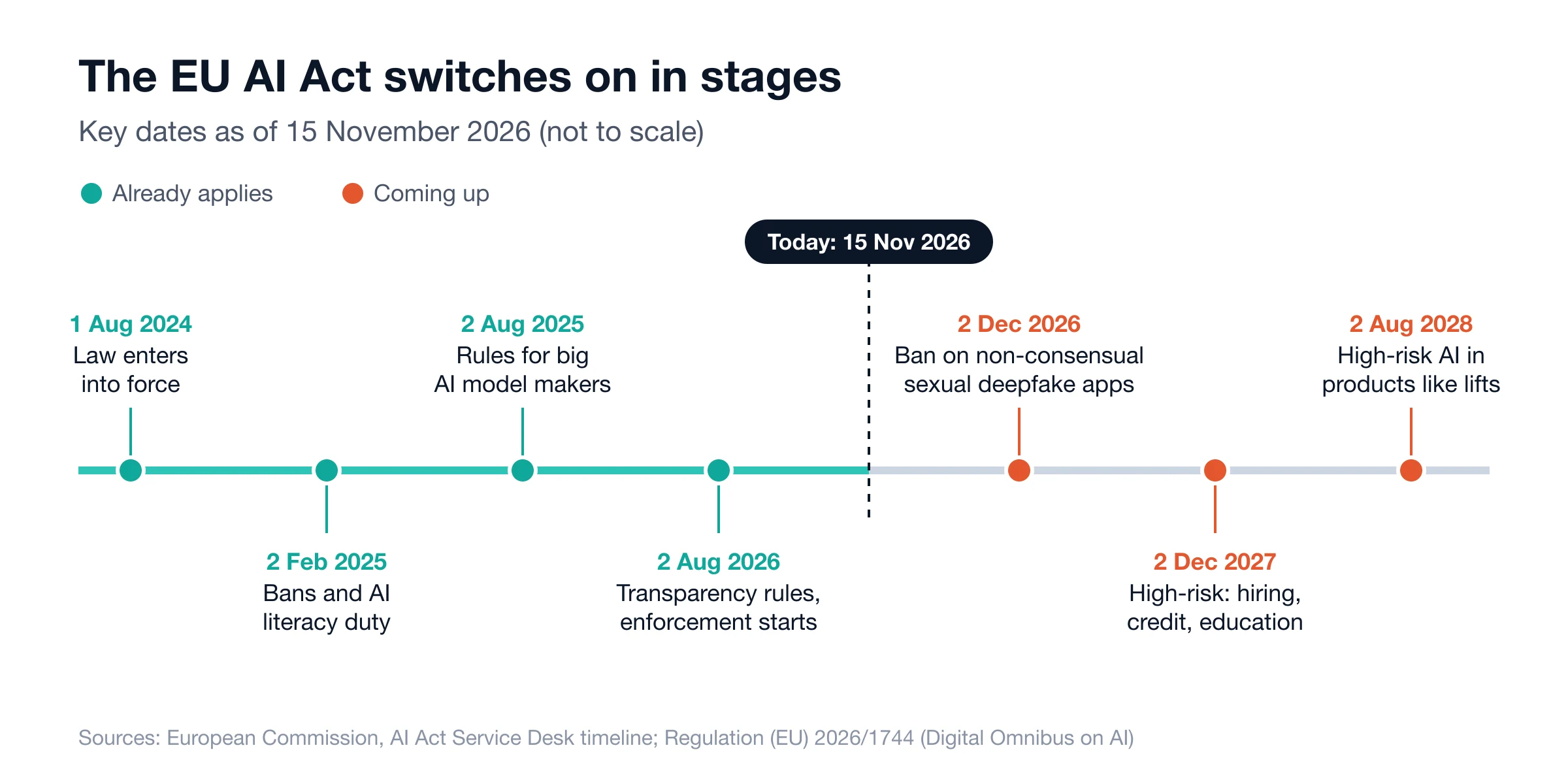
The omnibus gives its own reason for the delay: technical standards and national authorities weren't ready in time. It was proposed in November 2025, agreed on 7 May 2026 and took effect in late July.
The omnibus also softened the AI literacy rule. The old wording required companies to "ensure, to their best extent, a sufficient level" of AI literacy. The new text says companies "shall take measures to support the development of AI literacy" and need not guarantee any level for any individual.
The duty got lighter. It did not disappear.
Who checks in Germany (mainly the Bundesnetzagentur), and the maximum fines
Germany passed its own law to run the AI Act at home, the KI-Marktüberwachungs- und Innovationsförderungsgesetz (KI-MIG). The Bundestag adopted it on 11 June 2026, and it has been in force since 29 July 2026.
The main supervisor is the Bundesnetzagentur, Germany's federal network agency. It watches over AI in sensitive areas such as HR, education and critical infrastructure. It also handles complaints and checks the bans and transparency duties in its areas. Existing regulators keep their own sectors: BaFin, the financial regulator, covers AI used directly in regulated financial business, such as credit checks at a bank.
The Bundesnetzagentur runs a KI-Service Desk with an online tool that gives a first estimate of an AI system's risk level. It's a decent place to start before you pay anyone.
The AI Act sets maximum fines in Article 99. These are the upper limits:
- Using a banned AI practice: up to €35 million or 7% of worldwide annual turnover, whichever is higher.
- Breaking deployer or transparency duties: up to €15 million or 3%, whichever is higher.
- Giving authorities wrong or misleading information: up to €7.5 million or 1%, whichever is higher.
For small and medium-sized companies, the lower of the two numbers applies. Since the omnibus, firms a little bigger than SMEs, which the EU calls small mid-caps, also get the lower figure for the last two tiers. Germany's KI-MIG adds fines of up to €50,000 for breaking certain duties to cooperate with authorities.
The AI Act sets no fine for the AI literacy duty. It leaves penalties for other breaches to each country, and the German KI-MIG summaries from the Bundestag and Bundesnetzagentur name none for it. Our expectation: supervisors will ask for your training records before they reach for fines.
In our view, a big fine is unlikely for a typical company using ChatGPT and a website chatbot. The likelier cost is a complaint to the Bundesnetzagentur, or a large customer asking for your AI inventory before signing a contract.
What the EU AI Act requirements for companies mean in practice
Say you run a 60-person engineering firm. Staff use ChatGPT and Copilot, marketing makes images with an AI tool, and the website has a support chatbot. Here's what the law asks of you, in order of urgency.
1. Help your staff use AI sensibly
This is the AI literacy duty. The Commission's AI literacy Q&A suggests covering at least four things: what AI is and which AI your company uses, whether you build or only use it, what can go wrong, and how much each group of staff already knows. No certificate is needed. An internal record of who got which training is enough.
National supervisors have been able to enforce this rule since 2 August 2026, and sanctions must be proportionate. In practice, one hour of training per team, plus a one-page AI policy, beats a glossy e-learning course nobody finishes.
2. Write down where you use AI
You can't check what you haven't listed. Make a simple table: tool, team, purpose, what data goes in, who's responsible. Include AI features hidden inside software you already pay for. This list is what you'll pull out when a supervisor or a big customer asks.
3. Tell people when they deal with a machine
The AI Act's transparency article, Article 50, sets three rules that matter to most companies:
- Chatbots: people must be told they're talking to an AI, unless it's obvious. Strictly, this duty sits with the provider, the company that builds the bot or has it built and runs it under its own name (Article 3). In our reading, if you had a bot built and run it under your brand, that is likely you. If you plug in an off-the-shelf widget, it is usually the vendor. Either way, you're the one who can add the line.
- Deepfakes: if you publish AI-made images, audio or video that look real, you must say they're artificial.
- News-style text: if you publish AI-written text to inform the public on matters of public interest, you must disclose it, unless a person reviewed or edited it and your company takes editorial responsibility for it. So a company blog post that staff have checked usually needs no legal label.
The notice must be clear and come at the latest at the first contact. Our view: label anyway, even where the law might not strictly require it. A line saying "This assistant is an AI" costs nothing and saves an argument later. The Commission has even published EU icons for labelling AI content, which you can use voluntarily.
4. Check whether anything is high-risk
Does any tool help decide who gets hired, promoted or fired? Does any tool score people's creditworthiness, or grade students? Those are the high-risk areas. If you find one, December 2027 is your real deadline.
From then, under Article 26, a company using high-risk AI must, among other things, use it as the maker's instructions say and put trained people in charge of overseeing it. It must keep the system's logs, the records the system keeps automatically, for at least six months.
Before using one at the workplace, employers must tell the affected workers and their representatives. If your company has a works council (Betriebsrat), that means them. And people the system helps decide about, such as job applicants, must be told it is being used.
One trap: under Article 25, the law can treat you as the provider. That happens if you put your own name on a high-risk system, change how it works in a big way, or use a general-purpose tool for a high-risk purpose. Providers carry the heaviest duties. In our reading, a homemade CV-ranking setup built on ChatGPT is the textbook case.
5. Ask your vendors the right questions
Get written answers to these:
- Do you consider this system high-risk under the AI Act, and why or why not?
- Will you provide instructions for use and access to the logs?
- Does your tool mark AI-generated images, audio, video or text so they can be detected?
- Who do we contact if the system behaves wrongly?
A vendor that can't answer these in 2026 is telling you something.
A checklist for this quarter
Forward this list to whoever owns HR, IT and legal. It reflects the law on 15 November 2026 and is not legal advice.
- Name one person who owns AI rules in your company.
- List every AI tool and AI feature in use, with its purpose and owner.
- Hold a short AI training for each team and keep a record of who attended.
- Write a one-page AI policy: which tools are allowed, which data must never go in, and who to ask.
- Add a clear "you're talking to an AI" line to every chatbot and voice bot.
- Agree on how you label AI-generated images, video and published text.
- Flag any use in hiring, staff management, credit or education, and start planning for December 2027.
- Ask every supplier of a flagged tool in writing: is it high-risk and why, will you provide instructions for use and access to the logs, do you mark AI-generated content, and who do we contact if it goes wrong?
Most of this list takes days, not months. If you'd like a second pair of eyes on the inventory or the high-risk check, that's part of our AI consulting work.
The real deadline is your next customer audit
Two thirds of the companies Bitkom surveyed said the AI Act brings more disadvantages than advantages. We understand the frustration.
But the part that applies to most firms today is small: a training record, a list, a label on the chatbot. The companies that do it now will answer a customer's AI questionnaire in ten minutes. The ones waiting for December 2027 will scramble.
Our prediction: by 2027, "show us your AI inventory" will be as routine in German supplier audits as "show us your data protection policy" is today. Start the list this week.
This article explains the law as it stands on 15 November 2026. It is not legal advice. For decisions about a specific system, talk to a lawyer.
Frequently asked questions
What are the EU AI Act requirements for companies that only use ChatGPT or Copilot?
Companies that only use AI tools are called deployers. Today they must take measures to build AI skills among staff, label deepfakes and certain AI-written public texts, and avoid banned practices. In our reading, most office uses, like drafting emails, fall into the low-risk groups with no extra rules beyond staff training.
Has the EU AI Act been postponed?
Only partly. The Digital Omnibus on AI, in force since 27 July 2026, moved the high-risk rules to 2 December 2027 for areas like hiring and credit, and to 2 August 2028 for AI built into products. The bans, the AI literacy duty and the transparency rules were not postponed.
Is AI training for employees mandatory under the EU AI Act?
Partly. Since the July 2026 change, companies must take measures to support their staff's AI skills, but the law doesn't require a set format or a guaranteed level. Short training plus an internal record is the usual way to show it.
Who enforces the EU AI Act in Germany?
Since 29 July 2026, the Bundesnetzagentur is the central market surveillance authority, contact point and complaints office under the German KI-MIG law. Existing regulators keep their sectors, such as BaFin for AI used directly in regulated financial business.
How high are the fines under the EU AI Act?
Using a banned AI practice can cost up to 35 million euros or 7% of worldwide annual turnover, whichever is higher. Breaking deployer or transparency duties can cost up to 15 million euros or 3%, whichever is higher. For small and medium-sized companies, the lower of the two numbers applies. Small mid-caps get the lower number for the deployer and transparency tier too.
Sources
- Regulation (EU) 2024/1689 (Artificial Intelligence Act), EUR-Lex, Publications Office of the EU
- Regulation (EU) 2026/1744 (Digital Omnibus on AI), EUR-Lex, Publications Office of the EU
- AI Act, European Commission
- AI Omnibus enters into force, European Commission
- Timeline for the Implementation of the EU AI Act, European Commission, AI Act Service Desk
- AI Literacy - Questions & Answers, European Commission
- EU icons for labelling AI-generated content, European Commission
- Article 26: Obligations of Deployers of High-Risk AI Systems (consolidated text after the omnibus), EU AI Act Explorer (Future of Life Institute)
- Article 25: Responsibilities Along the AI Value Chain (consolidated text after the omnibus), EU AI Act Explorer (Future of Life Institute)
- Bundesnetzagentur übernimmt zentrale Rolle bei der Umsetzung der KI-Verordnung, Bundesnetzagentur
- Ja zur Durchführung der Verordnung über künstliche Intelligenz, Deutscher Bundestag
- Erstmals nutzt die Mehrheit der Unternehmen KI, Bitkom Research
- KI – Bundesnetzagentur (KI-Service Desk, KI-Compliance Kompass), Bundesnetzagentur
- Verordnung (EU) 2024/1689 (KI-Verordnung), EUR-Lex, Amt für Veröffentlichungen der EU
- Verordnung (EU) 2026/1744 (Digital-Omnibus zu KI), EUR-Lex, Amt für Veröffentlichungen der EU
- KI-Gesetz, Europäische Kommission
- KI-Kompetenz – Fragen & Antworten, Europäische Kommission